Showing posts with label soccer. Show all posts

Tuesday, June 22, 2010

Bad ref, bad!

It's official.

Officials, whether we call them referees or umpires, are starting to become more a part of the game than they should be.

There was Tim Donaghy, an NBA referee who in 2007 lost his career when he pleaded guilty to two counts of making calls during games to affect their point spread. More recently, there was Jim Joyce, an umpire who blew a call at first base, costing Tigers pitcher Armando Galarraga a perfect game against the Indians on June 2. On Friday in South Africa, there was Malian referee Koman Coulibaly, who disallowed the likely game-winning goal by the United States against Slovenia in the World Cup, leaving the game in its eventual 2-2 tie.

What is about the officials who are becoming as much a part of games as the players and coaches? Aren't they supposed to be in the background, nobly calling a game and making sure the players' skills shine through and be the only ones to affect the outcome?

Well, officials' mistakes aren't a new thing. There was umpire Don Denkinger, who called the Royals' Jorge Orta safe in Game 6 of the 1985 World Series, eventually leading to the Royals beating the Cardinals and eventually winning the series. During the World Cup qualifying in November 2009, the ref missed France's Thierry Henry's obvious handball against Ireland, leading to the winning goal that allowed the French to advance to the World Cup and knocking a strong Irish side out. In 1998 NFL referee Phil Luckett blew the coin flip call at the start of overtime of the Thanksgiving Day game pitting Pittsburgh and Detroit, saying the Steelers' Jerome Bettis called heads even though Bettis clearly said, "Tails," leading to the Lions' victory.

Now I can relate to a degree. I was a umpire for Little League games for a summer when I was in high school. I know I blew calls, and the parents and coaches let me hear it (though the kids were great). Officiating a game when others are depending on you making the right call and doing it fairly in the shadows in a rough deal.

Now I'm not comparing my experience with that of officials in higher-profile games, but I am talking about the officials' and the players' responses to the blown calls. Compare and contrast the aftermaths of the cases I brought up previously:

-- Tim Donaghy spent 15 months in federal prison for his part. Since his release, he has written a book telling his side of the story and has been a pain in the NBA's side.

-- The Cardinals, who were the favorites going into the 1985 World Series against the in-state Royals, could've come back against Kansas City and won Game 7, simply delaying the championship. Instead, they choked it away, getting blown out 11-0 and allowing George Brett and company to become heroes.

-- Phil Luckett was indirectly involved with another controversial on December 6, 1998, with officials on his crew allowing the Jets' Vinny Testaverde to score the winning touchdown against the Seahawks despite Testaverde clearly being stopped. That led to the NFL instituting instant replay in all games.

-- Swedish referee Martin Hansson let Thierry Henry's handball goal stand against Ireland, but regretted his mistake when he realized what had happened. An Irish sports officials offered his condolences, and Hansson was picked to be among the elite referees for the World Cup in South Africa. However, he has remained on the sidelines as an alternate fourth official, while the other European officials have called games.

-- The disallowed goal by Maurice Edu of the United States was not the only bad call Koman Coulibaly made in that game. He earlier gave American Robbie Findley a yellow card for an intentional handball, even though replays clearly showed the ball had gone off Findley's face and into his hands (and leading ESPN announcer Ian Darke to call it "the stupidest decision" he had seen in some time). FIFA referees said mistakes do happen, but they did not address the call in a media setting on Monday. Coulibaly, however, will not officiate any more games, at least during the first knockout stage.

The best response, however, was by Jim Joyce and Armando Galarraga. After the game, Joyce went straight to the umpires' room and watched the replay. He knew right away he had blown the call, and went looking for Galarraga. When he found him, he apologized immediately. Galarraga accepted the apology with no reservations and the next day, when Joyce worked behind the plate, the Tigers' pitcher brought out the lineup card.

Needless to say, that was the way to handle the situation. Clint Dempsey of the U.S. complained about Coulibaly allowing rough play to continue even though World Cup refs have said they would call games pretty closely. However, as a coach once told me, you don't put yourself in a position when a bad call could cost you the game. The U.S. could've played better in the first half and not stunk it up, allowing Slovenia to go 2-0 at the half and forcing them to have to come back.

You accept the human error and play the way you're supposed to play. If you play poorly and set yourself for failure, then you should accept whatever comes your way, good or bad.

Sunday, June 20, 2010

Blow, baby blow!

One of the big stories out of this World Cup has been the vuvuzelas, the plastic horns that South African fans have taken to blowing at full volume for the entire game, every game.

With the sound of a swarm of bees, many soccer fans, especially on this side of the pond, have come out and called them annoying, saying they are ruining the experience and wanting them banned. Players (like the French) have said they are unable to concentrate on the game.

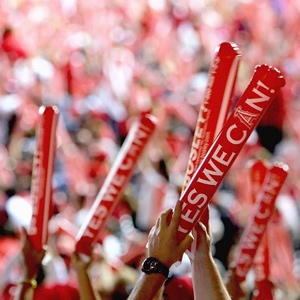
I'll say this: The vuvuzelas are part of the experience of South Africa soccer. They're no more annoying than Thunderstix, the Macarena at Yankee Stadium or any place, or the fans doing the tomahawk chop in any environment. If you can't concentrate during the game because of noise, go play tennis or golf where people are expected to shut up.

So in short, leave the horns alone.

British comedian Dave Benson came up with this great song on the vuvuzelas, based on Rihanna's "Umbrella."

Friday, June 18, 2010

U.S. Game Two and World Cup advertising

The United States play their second game of the 2010 World Cup today, this time against Slovenia, who is currently leading Group C with three points after beating Algeria on Sunday, 1-0 (The U.S. and England are tied for second place with one point due to their 1-1 draw on Saturday).

The good news is American goalie Tim Howard should be back in the net after suffering bruised ribs against the English. He'll be needed to ward off a surprising Slovenian attack, but the U.S. are the favorites against the small Eastern European nation.

I won't go so far as to call this a must-win for the Americans, but Slovenia is winning in the group with their win and England likely will take out Algeria. Three points, needless to say, would be good here.

Game time is at 9 a.m. CDT from Ellis Park in Johannesburg on ESPN. England and Algeria follow at 1:30 p.m. CDT on ESPN2.

But it's Friday, and what better way to kick off the weekend than with some great World Cup-related commercials.

Here's a fun one from BP airing in South Africa:


A boy works on getting another player to play the beautiful game with in this spot from Stratos, a candy company in Norway.


Pepsi has this spot featuring Ivory Coast's Didier Drogba, Brazil's Kaka, and Argentina's Lionel Messi:


World Cup Blog had labeled this Pepsi spot as positively the worst World Cup-related commercial to come out of the 2006 tournament in Germany. It features England's David Beckham and Brazil's Ronaldinho back when they were relevant to the game rather than just as celebrities.


And finally a spot on thinking positively from First National Bank of South Africa:


Happy Friday!

Tuesday, June 15, 2010

A day off...

Taking the day off. However, I will leave one impression of the U.S. National Soccer Team's 1-1 draw with England Saturday with you.


Have a good day.

Friday, June 11, 2010

U.S.A. ready for South Africa

Today, the World Cup will begin in Johannesburg, South Africa, when the host South Africa national soccer team takes on Mexico.

For U.S. and England fans, the big opener of course is Saturday when the two play in Rustenburg at 1:30 p.m. (ABC). This game could in a way tell us a lot about both sides' chance of advancing in this tournament, the first to be held in Africa.

The good news is both are in a reasonably easy Group C with Slovenia and Algeria, with the top two teams advancing to the knockout stage. Algeria is considered the weaker of some of the African teams, having managed to get past Egypt during qualifying, while Slovenia typically has not made much noise.

For the U.S., it's going to come down to overcoming injuries. Jozy Altidore hurts his ankle last week during the tune-ups, and while he is expected to play Saturday, the ankle will be tender. Plus, the U.S. also will have to be more consistent than it has been, with highs (a 3-1 win over Australia in the last exhibition last Saturday) and lows (a 4-2 beating on May 26 in East Hartford, Conn., at the hands of the Czech Republic, who didn't even qualify for the tournament this year in a tough European group).

What the U.S. team does after the group stage remains to be seen. It likely will draw someone like Germany or Ghana, against whom it will be the underdog. If it puts up a good showing against England tomorrow, with England expected by some like Sports Illustrated to make it to the final against Spain, the favorites to win it all, then the U.S. could go deep into this tournament like it did in 2002 in South Korea and Japan.

Sunday, June 6, 2010

The World Cup's coming to a galaxy near you...

Adidas has this great spot leading to the start of the World Cup later this week:

Thursday, July 2, 2009

U.S. soccer gain respect

The U.S. soccer team made a big splash last week when it snuck into the semifinals of the FIFA Confederations Cup in South Africa.

After losing 3-1 to Italy and 3-0 to Brazil, the U.S. looked dead in the water, and calls began coming in for the job of coach Bob Bradley. Going into its last game on June 21, the Americans would need a miracle to advance in that they had to beat Egypt by at least three goals and hope Brazil beat Italy by the same margin.

That miracle did, with the U.S.A. and Brazil both winning 3-0, and the Americans found their way into a semifinal match-up on June 25 with top-rated Spain, who were riding a 15-game winning streak and a 35-game unbeaten streak that dated back to the 2006 World Cup in Germany.

The miracle happens again, as the U.S. stunned the Spaniards 2-0 on goals by Jozy Altidore and Clint Dempsey, prompting headlines in the Spanish media such as "The United States destroys the legend of Spain" in El Mundo.

The difference-maker, however, was goalkeeper Tim Howard. A star with Everton in the English Premier League, Howard stopped 29 shots and what seemed to be a constant possession of the ball by the Spanish to help lead the U.S. into its first ever final in a FIFA tournament against Brazil on Sunday.

Lightning almost struck again as Altidore and Landon Donovan struck during the first half, giving the Americans an unlikely 2-0 lead at halftime. Could it happen? Could the U.S. actually beat the world's best, even if it was a tournament that is somewhat lightly regarded because it was seen more as a warm-up for next year's World cup and a test to see whether South Africa could actually pull off a world-caliber tournament?

Alas, as one reader mentioned in an e-mail to ESPN's Bill Simmons, the barrage of bullets finally struck Tim Howard. Brazil scored its first goal of the game barely two minutes into the second half, deflating any momentum the Americans had. Another Brazilian goal by Luis Fabiano came at the 73rd minute, and the game-winner followers 11 minutes later, sealing the victory and Brazil's third Confederations Cup title.

What does this mean for U.S. soccer? Does this mean the Americans can finally compete on the world stage, like was thought after the 2002 World Cup when the U.S. advanced to the final eight? That elusive tournament title remains out of reach, but if anything, the Americans gained respect.

However, to keep that respect, Bob Bradley and company are going to have to figure out a way to keep possession of the ball a little longer. Brazil kept the ball for most of the game, launching 35 shots at the goal. Eventually, Howard is going to crack, and he finally did in the final. Most winning teams, no matter the sport, tend to hang on to the ball. F.C. Barcelona, for example, tends to have possession of the ball for anywhere from 60 to 70 percent of the time, and that had to have helped them win the UEFA Champions League, Spanish League and Spanish Copa del Rey titles this past year.

Simply put, you can't score without the ball, and you can't win unless you score. It doesn't get much simpler than that, and Bradley and company will have to figure out how to solve that problems if they expect to first qualify for next summer's World Cup back in South Africa, and advance far, even possibly, miracle of miracles, winning that elusive trophy and stunning the world once again.

Copyright 2009 - Wait Til Next Century.